How clocks work part two: Quartz clocks

Clocks. We use them every day to measure the passing of time, but how do they actually work? Let’s take a closer look…

Quartz clocks

In the last post I made, I talked about how mechanical clocks work. The vast majority of modern clocks and watches are, however, not mechanical in nature, so today I’m going to talk a bit about the most common timekeeping technology found today – quartz clocks.

Quartz clocks work by taking advantage of a phenomenon known as the piezoelectric effect. Certain materials (including quartz, but also topaz, bone and many others) have the property that when they vibrate, some of the energy is converted to electrical energy, producing a current. By making something that vibrates at a constant frequency, we can produce a current that alternates at a constant rate. Like the balance wheel in the mechanical clock discussed last time, these constant oscillations can be used to keep track of time.

So how do we get the quartz to vibrate at a continuous speed? Those of you who are musicians may be familiar with tuning forks. Tuning forks are specially shaped pieces of metal that vibrate at a particular frequency to produce a tone, a pure musical note. It just so happens that we can use the same shape to have the same effect with quartz crystals. The quartz is shaped into a tiny tuning fork, which then has blobs of metal attached to the ends. These blobs can be etched away with a laser to finely control the weighting and shape of the fork, and therefore the frequency of its vibration. All that remains is to have some clever circuitry to count these vibrations and move the hands of the clock (or change the display if it’s a digital clock) so we can keep track of time accurately and fairly inexpensively.
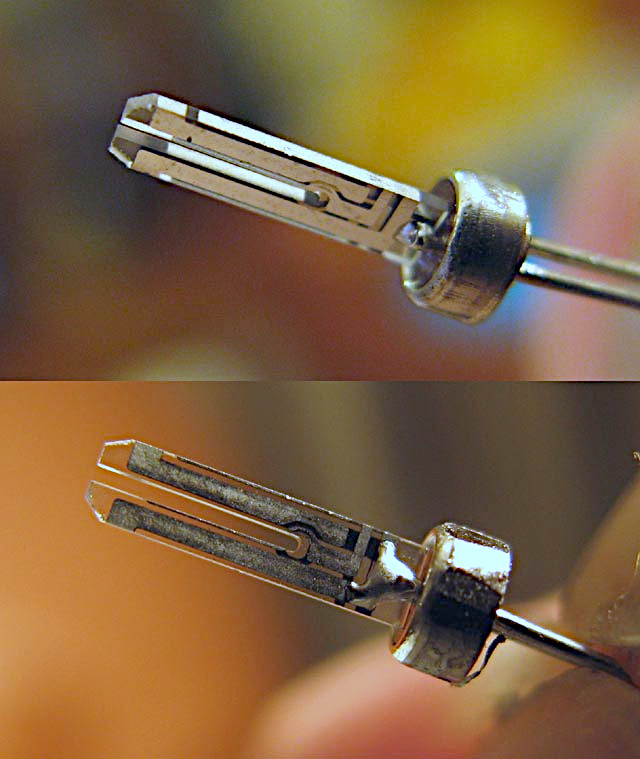
Quartz crystal resonator shaped as a tuning fork. (Image source: Wikipedia)

Here’s a video explaining in a bit more detail:

How clocks work part one: Mechanical clocks

Clocks. We use them every day to measure the passing of time, but how do they actually work? Let’s take a closer look…

Part 1: Mechanical clocks

Mechanical clocks have a long and complex history – the earliest clocks were powered by water, but in the late 13th to early 14th century, the source of power was changed to falling weights – a more efficient source. However, simply letting weights fall naturally unopposed under gravity offers little control over how the power is applied, and solving this problem led to the invention of one of the most useful and fantastically ingenious mechanisms ever made – the escapement.

But more on that in a second – clearly there are no falling weights in a mechanical wristwatch, so what source of power is used today? There is a clue to the answer in the fact that mechanical watches require winding in order to keep going – a tightly wound spring under tension does the job of driving the mechanism nicely. This spring is called the mainspring, and as it unwinds it causes a wheel (the barrel) to rotate.

Mainspring in barrel. (Image source: WEC Design)

The barrel is connected to a series of gears which have the effect of scaling up the motion, so that one rotation of the barrel can cause multiple rotations of other parts. This allows you to go for longer before having to wind up the watch again. This is all fine so far, but in order to measure time, we need to be able to count something that changes at a regular pace – this is where the balance wheel comes in.

The balance wheel is a wheel mounted on yet another spring, called the hairspring. Unlike the mainspring, the hairspring is not wound by the user and does not power the mechanism. Its purpose is to reverse the direction in which the balance wheel is spinning at regular intervals; we can measure the rate at which these directional changes occur and use this to tell how much time has passed.

Balance wheel

Of course, if the balance wheel is simply connected to the gear train set up above, the clock will slow down over time – as the mainspring unwinds the tension decreases. The ingenious solution to this problem, as mentioned above, is the escapement. Here is an animated diagram to give you an idea of what’s happening before I go into a fuller explanation:

The escapement consists of several parts. The spiky looking wheel is called the escape wheel, and that is the part that is connected to the gear train (and hence also to the mainspring). The wheel is prevented from rotating freely by the fork-like component, which is known as the pallet. The pallet causes the wheel to move in steps, making the pallet rock back and forth. The other end of the pallet is connected to the balance wheel, and it is the continuous oscillatory movement of the pallet, given energy from the mainspring by being pushed a little at a time by the escape wheel, that keeps the balance wheel rocking back and forth at a constant rate (usually 18000 beats per hour – 5 per second).

Still not sure exactly how the parts fit together? The following video provides a fantastic explanation by building a giant model clock clearly showing all the bits mentioned above:

The fact that all these parts, precision calibrated and manufactured to strict tolerances, can be placed into a space the size of a wristwatch and last for decades with nothing more than some regular winding is a marvel of invention and human skill.


Newton’s laws of motion

English: Isaac Newton Dansk: Sir Isaac Newton ...

Sir Isaac Newton (1642-1727) (Photo credit: Wikipedia)

Sir Isaac Newton was an English Physicist and Mathematician who worked on many areas of science and maths in the seventeenth century. The number of things he worked on was quite impressive, ranging from gravity to optics (he discovered that white light is made up of many colours) to his work in developing calculus. One of the things Newton is most remembered for is laying the foundations of Classical (sometimes called Newtonian) Mechanics, the physics of moving objects. The basis of this branch of physics are Newton’s laws of motion, so without further ado, let’s take a look at the first law.

Newton’s First Law of Motion:

An object will remain in a state of either rest or constant velocity unless acted upon by a resultant force.

Let’s unpick this a little. Everything is either at rest – so not moving (in which case it has zero velocity), or in motion, in which case it has some velocity. Velocity is simply speed in a certain direction. If I drive north at 40 miles per hour, my velocity is 40 mph north. I could also say I have velocity of negative 40 mph to the south. The first law tells us that if no resultant force acts on an object it’s velocity will not change. If it is at rest it will stay at rest. If it is moving it will keep moving at the same speed in the same direction in a straight line forever – unless a resultant force acts on it. What do we mean by resultant? Think of a shopping trolley being pushed along. As you push it in a straight line, you are exerting a force on the trolley by pushing it, right? But it isn’t changing speed or direction, so what gives? What’s happening is that your push is not the only force at work. As you push the trolley there is also friction between the wheels and the floor and air resistance to work against you. As it happens, the forces trying to push the trolley the other way balance out the force you are creating – there is no resultant (net) force acting on the trolley, so it’s velocity must remain constant.

Newton’s Second Law of Motion:

The force acting on a body is equal to its mass multiplied by its acceleration.

This is usually expressed in the form of an equation, F = ma. It tells us many things. Firstly, that you need a bigger force to give the same acceleration to an object with more mass, or to give an object with the same mass a bigger acceleration. It also tells us that both a force and the acceleration that results from it are in the same direction as each other. It is important to note here that in physics, acceleration means a change in velocity. This could be speeding up, slowing down (negative acceleration), or changing direction. It could even be changing speed and direction. Finally, Newton’s Second law gives us the SI unit (confused? see the post on SI units here) for force. Mass is measured in kg, while acceleration is measured in ms-2, so the unit for force must be kgms-2. We call this unit the Newton (I think you can guess why).

Newton’s Third Law of Motion:

When a body exerts a force on another body, the second body exerts a force – of the same type, of equal magnitude, and in the opposite direction – on the first body.

Wow – that’s a lot of jargon. Allow me to simplify: Newton’s third law is sometimes stated as “every action has an equal and opposite reaction”. So when you walk into a lamppost, it pushes back against you. When you jump off the ground, you push the Earth away from you just as it pushes your feet – and when you fall back down due to gravity, your own gravity pulls the Earth up. This seems a little crazy until you take a look at it in the context of the second law – even though the force you exert on the Earth is the same as its pull on you, its mass is much, much bigger, so it only accelerates by a tiny amount.

The metric system

The seven SI base units and their interdepende...

The seven SI base units and their interdependency in terms of how they are defined. For example, there’s a line from s to m because 1m is defined as the distance light travels in a vacuum in a certain amount of time (measured in s). (Photo credit: Wikipedia)

Ever wondered why people use inconvenient forms of measurement for simple things? Take one foot. It consists of twelve inches, while three feet make a yard and 1760 yards make a mile. These numbers, based off traditional ways of measuring things, aren’t very easy to calculate with, and for this reason the metric system was introduced at the end of the eighteenth century by French Revolutionaries.

So how exactly does the metric system work? Well, the system is based off the convenience of using multiples of ten in calculations, hence we have ten centimetres in a decimetre, ten decimetres in a metre and so on. But it’s not just for lengths. The modern version of the metric system – what the original 18th century version evolved into – is the International System of Units. In French, this is  Système international d’unités which is where we get the abbreviation of SI from. There are seven base units  in the SI system:

  1. Metre, symbol m, used for measuring length
  2. Kilogram, kg, used for measuring mass (not weight! But that’s a topic for another post)
  3. Second, s, used for measuring time
  4. Ampere (often shortened to amp), A, used for measuring electric current
  5. Kelvin, K (not °K!), used for measuring temperature
  6. Mole, mol, used to measure amount of substance (this will be familiar with students of chemistry)
  7. Candela, cd, used to measure luminous intensity

(Interesting fact: sharp-eyed readers may have noticed that some units are capitalised, like A for Amperes or K for Kelvin, while others are not, like m for metres. Units which are named after people (usually famous scientists), have capital letters, while the others don’t)

Seven units may not seem that much at first – what if you want tomeasure something which isn’t on the list above, like area or electric charge or force? Well, the true beauty of the SI system is that every single other unit used in science can be derived by combining base units using multiplication or division. For example, area is measure in m2  and electric charge is measured in Coulombs, where 1 C = 1 As (Amps times seconds). Force is a little more complicated (for the record, force is measured in Newtons: 1 Newton is 1 kgms-2. This comes from Newton’s second law of motion, which I’m hoping to cover soon). So whatever you want to measure, you can measure it in SI units

However, all this doesn’t answer the question of why anybody would want to use SI units instead of imperial units. The answer to that lies, as mentioned above, in the ease of calculation that comes from using powers of ten. You see, in front of any unit, you can put a prefix which tells you to multiply it by a certain power of ten. This is the difference between, say, a gram and a kilogram, or a second and a millisecond. The most commonly used prefixes are in the list below:

For small things:

  • centi- divide by 100 (symbol c)
  • milli- divide by 1,000 (m)
  • micro- divide by 1,000,000 (μ)
  • nano- divide by 1,000,000,000 (n)

For big things:

  • kilo- times by 1,000 (k)
  • mega- times by 1,000,000 (M)
  • giga- times by 1,000,000,000 (G)
  • tera- times by 1,000,000,000,000 (T)

Because everything is based of multiples of ten, and every unit can be derived from just seven base units, SI does away with much of the needless complexity of the Imperial system, and is now the standard system of measuring for science and engineering (and most countries, with the biggest exception being the USA).

Chaos Theory

weather

Weather is a deterministic chaotic system (Photo credit: born1945)

Chaos theory deals with something we call a deterministic system. Don’t be put off by the fancy-sounding name – all this means is a system with no randomness involved. If we know the exact state of our system at a particular instant and all the rules that govern it, we can predict with perfect accuracy what it will look like the next instant, and at every point in time afterwards. Doesn’t seem very chaotic, right ?

Right. That’s because in chaos theory, we’re only interested in deterministic systems where we don’t know all the conditions with perfect accuracy. The theory essentially says that because we don’t know all the conditions exactly, we can’t predict how our system will behave in the future. This is because even tiny differences in the initial conditions can eventually lead to massive discrepancies in the final state of the system. Here’s an example (from the excellent book “Professor Stewart’s Cabinet of Mathematical Curiosities” by Professor Ian Stewart):

Suppose our system’s input consists of an infinitely long decimal number between 0 and 10. At time 0, this number is 5.430874 to six decimal places. To make things simpler, let’s have time run in separate “chunks” (mathematicians say these are “discrete intervals”, that is, you can count them individually), instead of continuously. The rule for our system is as follows:

The state after one “chunk” of time has passed is found by multiplying the number from the previous state by ten, and deleting the first digit.

So the first six “chunks” of time look like this:

  • 5.430874…
  • 4.30874…
  • 3.0874…
  • 0.874…
  • 8.74..
  • 7.4…

Okay, now for the chaos. Imagine if, when we wrote down our input, we accidentally put a 2 instead of that 7. Now watch what happens to the state of our system:

  • 5.430824…
  • 4.30824…
  • 3.0824…
  • 0.824…
  • 8.24…
  • 2.4…

After six chunks of time, we have a completely different output because of a minor error in our input. The original difference of 0.00006 has become a difference of 6. Of course, in real life deterministic systems can be much, much more complicated than this.

Consider the weather – we have equations from physics that tell us how heat flows, how gases move, how rain should move through the air as it falls – we know the rules of our system, but there are limits to how accurate our input data is. We can never know the exact temperature of every individual point on the planet, or the exact wind speed in a certain area. And even though in theory, we could put all the information in a computer and get it to predict what will happen, the tiny errors in our data stop us from being able to accurately predict anything past a couple of days. The system may be deterministic, but we can’t accurately predict how it will end up, and that makes it chaotic.

Autumn leaf-colour

Autumn colour, Bollitree - geograph.org.uk - 1...

Autumn colour, Bollitree – geograph.org.uk – 1559556 (Photo credit: Wikipedia)

For most of the year, leaves are green. This is due to a green chemical in leaves called chlorophyll – the same chemical used in photosynthesis, the process by which plants use sunlight to make food. When the days begin to get shorter in the autumn there isn’t much sunlight around, so some trees shed their leaves in order to save energy over the winter. As the leaves prepare to fall off, they turn from their usual green colour to various shades of orange, red and yellow.

During the year, the green chlorophyll in the leaves continually breaks down and is replaced by new chlorophyll. There are also other pigments in the leaf which have different colours, such as yellow xanthophylls and orange beta-carotene; however, these are obscured by the colour of the chlorophylls, which are present in much greater numbers. When autumn comes, the veins which supply the leaf with fresh chlorophyll are blocked off by special cork cells in preparation for the leaf dying and falling off the tree. As the chlorophyll breaks down, the other pigments remain, causing the leaves to turn from their usual green colour to the colours of the other pigments.

Noise cancelling headphones

English: Constructive (a) and destructive (b) ...

Constructive (a) and destructive (b) interference of two waves (Photo credit: Wikipedia)

Noise cancelling headphones block out background noise to give whoever is using them the best listening experience possible. They do this by using the power of sound waves.

Sound travels through the air as waves, alternating patterns of higher and lower air pressure. When waves, including sound, meet each other, they will interfere to form a new wave. The way in which this happens depends on the waves themselves – if, when the waves meet, the high parts and low parts on one wave align with those on the other, constructive interference occurs. The overall effect is a wave twice as big as the original.

The opposite of this is called destructive interference, and it happens when the high parts on one wave line up with the low parts on the other  and vice versa (the waves are said to be in antiphase). If both waves have the same amplitude and frequency (in terms of sound, these are volume and pitch, respectively), but they are exactly in antiphase, the waves will completely cancel each other out, leaving behind no wave at all – and importantly, for noise cancelling headsets, this means no sound.

So how can noise cancelling headphones use the phenomenon of destructive interference to get rid of background noise? In every pair of noise cancelling headphones, there is at least one microphone which picks up external noise (unwanted sound). These sound waves are analysed  electronically by the headphones, which then produce a wave with the same frequency and amplitude, but in antiphase. The two waves cancel each other out, so whoever is wearing the headphones can enjoy whatever they are listening to without annoying background noises.

An interesting limitation of noise cancelling technology is that while it is good at cutting out continuous background noise, for example the drone of an aeroplane engine, it doesn’t cope so well with getting rid of things like human speech. This is because when a person speaks, their pitch and volume – and therefore the frequency and amplitude of the sound they produce – is constantly varying. This means that by the time the headphones have produced their own wave to cancel the noise, it has changed to something else.

Why is the sky blue?

English: A dispersive equillateral prism refra...

White light is split into all colours by a prism (Photo credit: Wikipedia)

This is a question often asked by little kids, and one which parents may find themselves at a loss to answer. The sun emits white light, which is actually a mixture of all different colours. We know this thanks to Isaac Newton‘s experiments with light, and it’s fairly simple to prove – shine white light through a prism and it will split into the colours of the rainbow (this is actually where rainbows come from; water droplets from rain act as prisms to split the light).

But if sunlight is naturally white, why does the sky appear blue? After all, it’s just air right, and air at ground level doesn’t seem to change the colour of the light much does it? The answer is that as the sunlight shines through the atmosphere, the light is scattered by particles in the air. When the light is scattered, it moves in all directions, including towards our eyes. Different wavelengths of light correspond to different colours and are scattered by different amounts – those which scatter more lend their colour to whatever they are coming off. It just so happens that blue light hitting particles suspended in the atmosphere is scattered more, while other colours tend to be absorbed. The overall effect of this is that the sky appears blue.

The reason we don’t see the air at ground level as blue is that we aren’t looking through so much of it. Light coming down through the atmosphere comes through thousands of kilometres of air, so scatters more easily. If you’ve ever wondered why aeroplanes can land in fog so thick you can’t see more than a few metres in front of you, it’s pretty much the opposite – we on the ground look through all the fog in front of us, while looking down from above the pilots only have to see through a thin layer until the plane is close to the ground, giving them decent visibility in all but the thickest fog.

Fire

Chemical Reaction

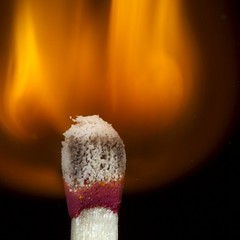
Flaming match (Photo credit: lindes)

When things are heated up enough, they often burst into flames. Fire is caused by substances reacting chemically with oxygen (usually from the air). This reaction causes energy to be released as heat and light, which we see as flames.

To keep a fire going, three things are needed – heat, oxygen and fuel (something to burn). Together they form the fire triangle. Fire extinguishers work by removing one or more of these things, stopping the flames in their tracks.For example, spraying heavy carbon dioxide gas on a fire stops oxygen from reaching it, starving the flame.

Interestingly, by burning different substances, we can produce flames of different colours. Most of us are familiar with the orangey-red flames of burning wood, while alcohol produces a blue flame (think Christmas pudding). Knowledge of flame colours from different chemicals is useful to people who design fireworks, allowing them to produce a massive array of different colours to illuminate the night sky.

The Northern Lights

Aurora Borealis over Esja, Reykjavík

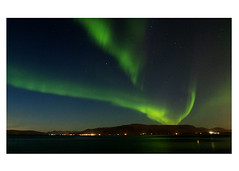
Aurora Borealis over Esja, Reykjavík (Photo credit: omblod)

The Northern Lights, also referred to by astronomers as the aurora borealis (as opposed to the aurora australis – the Southern Lights), casts a mesmerising glow over the Arctic ice – but what exactly is it?

Well, as it happens, the light display which so captures our imaginations (not to mention draws tourism trade to isolated northern towns that might otherwise not exist)  is caused by the interaction of charged particles from the solar wind with the Earth’s upper atmosphere.

The Earth essentially acts as a giant magnet, which is why compass needles point north – but compass needles aren’t the only thing pulled by the poles . The sun constantly emits a solar wind of highly energetic charged particles which can be directed by the Earth’s magnetic field towards the north and south poles. At these regions, they collide with nitrogen and oxygen molecules in the air, causing them to gain energy. This energy is lost as light, with the colour depending on the amount of energy transferred. Oxygen atoms tend to produce green or brownish-red lights, while nitrogen atoms give out red or blue light. These combine to form spectacular displays which sweep across the skies.